Monday, February 27, 2017

Fear and Corruption in Video Games


Horror fans have been arguing with movie screens for years, as the viewers know there are certain unwritten rules that tend to determine a character’s chances of survival. Anyone who has seen Scream can tell you that “there are certain rules that one must abide by in order to successfully survive a horror movie:”

  •  Never have sex (part of the sin factor)

  •  Never drink or do drugs (part of the sin factor)

  •  Never say “I’ll be right back”

Nonetheless horror movie fandoms will tell you there are others. For instance, don’t look behind you while you’re running, because you will fall down. If you are being chased, don’t go upstairs because there is no exit on the second floor. Also, never show mercy to the murderer, because he is never dead when you think he is, so always double-tap. 

http://i3.kym-cdn.com/photos/images/facebook/000/542/802/a29.png

But this is where horror movies and horror video games diverge. In order to make it through a horror game, you must violate these rules. When you access their moral schemata and expectations, you must often betray them. You have to go investigate the creepy noise or explore the dark dilapidated attic to continue the storyline, and game developers know this. 

According to Reed (2016), developers use “corruption rhetoric” to push players out of their comfort zones in an effort to produce fear and repulsion in players. The concept of corruption rhetoric consists of schema theory (and individual’s knowledge of experiences that are believed to be true) of and expectancy violation theory (the violation of appropriate behavior that has been previously established by patterns in societal norms) being used as rhetorical devices.  Therefore, by determining a gamer’s schema frameworks and expectations, and then violating them, a game can produce shock, fear, and revulsion. 

For instance, Reed cites Resident Evil as a game that uses corruption of media (the use of radios for S.T.A.R.S. contact), corruption of nature (the use of zombies), corruption of architecture (the gothic mansion) and corruption of authority (the face of the Umbrella Corporation as a dummy corporation) to create a specific gaming environment that violates players’ expectations. 

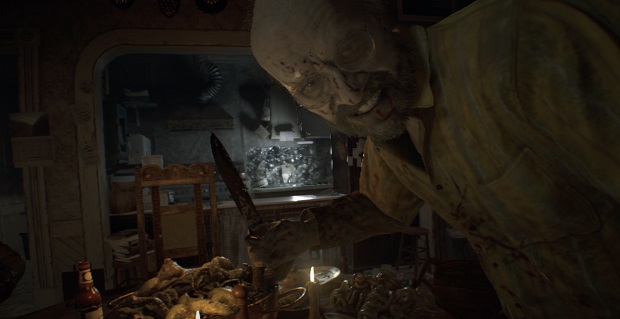
The game series’ most recent release, Resident Evil 7: Biohazard, has returned to recipe. The game is set in rotting Louisiana mansion that has a reputation for being haunted (corruption of architecture). You travel to this mansion in order to rescue your missing wife, who later attacks you out of nowhere (corruption of authority). Throughout the story, you learn about the past visitors of the mansion through VHS tapes strewn about (corruption of media). What you find is a very disturbed “family environment” that increasingly points to cannibalism and disease (corruption of nature). Biohazard developers determined their audience’s horror schemata and exploited them and create the game’s corruption rhetoric. 

https://www.rockpapershotgun.com/images/17/jan/resiheader.jpg

But what if, instead of placing the burden of determining the audience’s schemata and expectations, the game itself learned about the individual playing it? Until Dawn uses gameplay to learn about the player, and then adapts to the individual’s schemata, creating an opportunity to deliver an increased fear factor.   

http://i.imgur.com/3VfMnWo.jpg

For instance, throughout Until Dawn gameplay, you are sporadically entered into a therapy session with an analyst. The analyst asks about your fears and relationships with other characters. Your answers, along with the decisions you make and their consequences, determine the storyline and ending you will experience. If survival horror video game developers can follow this adaptation model while delivering a game that follows the corruption rhetoric model, future horror video games will surely elicit increasingly powerful fear responses in gamers.  


References
Gazano, E. (2011). Scream Rules. YouTube. Retrieved from https://www.youtube.com/watch?v=Yov9SzmpwjE
Reed, C. (2016). Resident Evil’s rhetoric: The communication of corruption in survival horror video games. Games and Culture, 11(6), 625-243.

Monday, January 30, 2017

Individuality in Video Games


Violent video games have been an area of concern for the researchers and the general public alike for decades. However, research methodology and results have been inconsistent, and tend to focus on the effect violent video games have on a player’s real-life actions. While some research correlates playing violent video games with an increase in criminal thinking or desensitization, other research shows that playing violent video games results in a mediating affect. 

Image result for Fatality

Nonetheless, as video games evolve, so do their role in society. For instance, McKernan (2010) analyzed coverage of video games in The New York Times from 1980 to 2010.  His analysis found that video games were described as a societal threat in earlier years (the 80s and 90s), but their descriptions evolved in the 2000s, leading to an acceptance of video games as a form of art.
Researchers’ focus has also evolved. Recently, how players’ personality traits affect interactions with video games has become a topic of interest. One area of thought is that certain individual characteristics may make specific players vulnerable to violent video games.

Markey and Markey (2010) focused on players’ levels of psychoticism and the relation to violent video games. The researchers’ definition of psychoticism is conceptualized as an individual who tends to be “cold, lacking in sympathy, unfriendly, untrustworthy, odd, unemotional, unhelpful, antisocial, and paranoid” (p. 82). Their results found that players with a higher level of psychoticism tended to react more aggressively and hostile after being exposed to violent video games.

This research raises another pertinent question: If a player’s personality traits affect the way video games influence real-life interactions, how do they affect the way a player interacts within a video game? Joeckel, Bowman, and Dogruel (2012) examined the decision-making processes of players during gameplay. They found that participants tended to make decisions within video games by following their moral instincts. However, when game cues present an immoral environment, they will likely follow the corrupt avenue in an effort to enjoy gameplay within the virtual world parameters.

Related image

Future research will be key when determining what type of role video games play in popular culture, as well as psychology. There are many aspects that are continuously being explored, but more information regarding in-game interactions with moral decision-making processes, and how personality traits inform those interactions, will offer insight into the importance of this popular art form on players and the general public.


References
Joeckel, S., Bowman, N. D., & Dogruel, L. (2012). Gut or game? The influence of moral intuitions on decisions in video games. Media Psychology, 15, 460-485.
Markey, P. M. & Markey, C. B. (2010). Vulnerability to violent video games: A review and integration of personality research. Review of General Psychology, 14(2), 82-91.
McKernan, B. (2013). The morality of play: Video game coverage in The New York Times from 1980 to 2010. Games and Culture, 8(5), 307-329.
Schulzke, M. (2010). Defending the morality of violent video games. Ethics of Information Technology, 12, 127-138.

Monday, January 23, 2017

Welcome to my video game blog

For this blog, I am planning on focusing on the concept of morality in regards to video games. The main question I would like to investigate is: How does an individual's personality traits and personal morality affect gameplay?

The idea of personal choice has been increasingly embedded in video games. From the games that I have played, there seems to be two different kinds of personal choice video games: binary and non-binary.

When I refer to games with a binary morality, I am describing those games that give you two options within the storyline. More specifically, you have the choice of whether to be a hero or a villain, or, in other words, good or evil. The Infamous game series is an example of binary moral choice in video games. In this series, the storyline and power-ups will change depending on whether the player decides to be a hero or a villain.

Non-binary moral choices are the decisions that players make within a game that are not "black and white" and don't have "correct" answers in regards to good and evil, or hero and villain, tropes. These choices, similar to binary choices, have an effect on storyline and character progression. TellTale's The Walking Dead video game series is an example of a video game series that includes non-binary choices. While choices in this game series do not necessarily make the player good or evil, they have long-lasting effects within the game, as well as future installments in the series.

I have read a couple of studies on the subject of individuals' morality and its effects on gameplay, however I have barely scratched the surface. Learning more about how morality, and, in turn, personality traits, affect gameplay is an important area of research. Not only will it provide an insight into how video games reflect each individual, but it may also provide an avenue to further research in areas such as game development, video game addiction diagnoses and treatment, video game marketing, and many others.