Horror fans have been arguing with movie screens for years,
as the viewers know there are certain unwritten rules that tend to determine a
character’s chances of survival. Anyone who has seen Scream can tell you that “there are certain rules that one must
abide by in order to successfully survive a horror movie:”
- Never have sex (part of the sin factor)
- Never drink or do drugs (part of the sin factor)
- Never say “I’ll be right back”
Nonetheless horror movie fandoms will tell you there are
others. For instance, don’t look behind you while you’re running, because you
will fall down. If you are being chased, don’t go upstairs because there is no
exit on the second floor. Also, never show mercy to the murderer, because he is
never dead when you think he is, so always double-tap.

But this is where horror movies and horror video games
diverge. In order to make it through a horror game, you must violate these
rules. When you access their moral schemata and expectations, you must often
betray them. You have to go investigate the creepy noise or explore the dark
dilapidated attic to continue the storyline, and game developers know this.
According to Reed (2016), developers use “corruption
rhetoric” to push players out of their comfort zones in an effort to produce
fear and repulsion in players. The concept of corruption rhetoric consists of
schema theory (and individual’s knowledge of experiences that are believed to
be true) of and expectancy violation theory (the violation of appropriate
behavior that has been previously established by patterns in societal norms) being
used as rhetorical devices. Therefore,
by determining a gamer’s schema frameworks and expectations, and then violating
them, a game can produce shock, fear, and revulsion.
For instance, Reed cites Resident Evil as a game that uses corruption of media (the use of
radios for S.T.A.R.S. contact), corruption of nature (the use of zombies),
corruption of architecture (the gothic mansion) and corruption of authority
(the face of the Umbrella Corporation as a dummy corporation) to create a
specific gaming environment that violates players’ expectations.
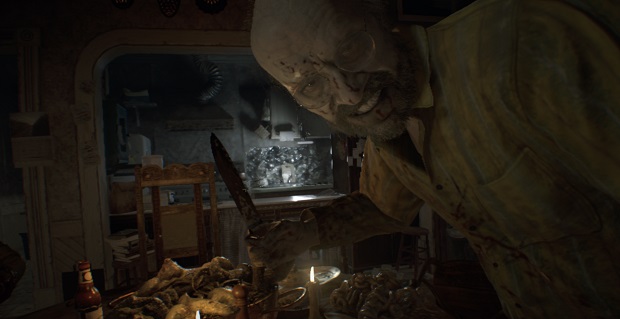
The game series’ most recent release, Resident Evil 7: Biohazard, has returned to recipe. The game is set
in rotting Louisiana mansion that has a reputation for being haunted
(corruption of architecture). You travel to this mansion in order to rescue
your missing wife, who later attacks you out of nowhere (corruption of
authority). Throughout the story, you learn about the past visitors of the
mansion through VHS tapes strewn about (corruption of media). What you find is
a very disturbed “family environment” that increasingly points to cannibalism
and disease (corruption of nature). Biohazard developers determined their
audience’s horror schemata and exploited them and create the game’s corruption
rhetoric.
But what if, instead of placing the burden of determining
the audience’s schemata and expectations, the game itself learned about the
individual playing it? Until Dawn
uses gameplay to learn about the player, and then adapts to the individual’s
schemata, creating an opportunity to deliver an increased fear factor.

For instance, throughout Until Dawn gameplay, you are sporadically entered into a therapy
session with an analyst. The analyst asks about your fears and relationships
with other characters. Your answers, along with the decisions you make and
their consequences, determine the storyline and ending you will experience. If
survival horror video game developers can follow this adaptation model while
delivering a game that follows the corruption rhetoric model, future horror
video games will surely elicit increasingly powerful fear responses in gamers.
References
Gazano, E. (2011). Scream Rules. YouTube. Retrieved from https://www.youtube.com/watch?v=Yov9SzmpwjE
Reed, C. (2016). Resident Evil’s rhetoric: The communication
of corruption in survival horror video games. Games and Culture, 11(6), 625-243.
